
THE ROCKEFELLER-ROSWELL
UFO CONNECTION REVEALED
OCTOBER / NOVEMBER 2026

A prominent member of one of America's wealthiest and most influential families—the Rockefellers—spent years, considerable resources—and even enlisted the efforts of other family members—trying to unravel the truth behind the UFO phenomena and especially of the famous 1947 Roswell UFO incident. Laurance Rockefeller brought the mystery into the Clinton White House, sought the attention of a President and First Lady, and worked directly through President Clinton's science adviser, John Gibbons. He wanted the government to open its files and determine what had really happened in the New Mexico desert. What motivated him to pursue the case so intensely and what did he learn? Investigation has also uncovered that Rockefeller and his family were very closely associated with a scientist—Dr. Vannevar Bush—implicated by credible sources as having been privy to reverse engineering of a crashed UFO.
ROCKEFELLER AND UFOS AND ROSWELL
Laurance Spelman Rockefeller was hardly a conventional UFO investigator. A billionaire, Navy veteran, businessman, conservationist and philanthropist, he invested in advanced technology ranging from aerospace and electronics to optics and lasers. By the early 1990s it had become obvious that UFOs and extraterrestrial intelligence had become serious concerns for him. In March 1993, his attorney Henry Diamond contacted Clinton's Science Advisor John Gibbons about "the potential availability of government information about unidentified flying objects and extraterrestrial life." Rockefeller was not asking the White House simply to believe in flying saucers. He wanted the government to determine what it actually knew.
Roswell quickly became the test case. In February 1994, Rockefeller told Gibbons that the 1947 Roswell UFO crash incident was "a logical and challenging place to start." He proposed using Roswell to test whether the government was genuinely willing to review classified UFO information. If the evidence showed no UFO was involved, that would settle an important controversy; if it did not, the government would have to confront something genuinely unexplained. Rockefeller was not publicly declaring Roswell extraterrestrial. He was demanding that the files be opened and the question answered.
The timing was remarkable. Congressman Steven Schiff had already pushed Roswell into the congressional arena, with the GAO beginning its own investigation of the crash. At virtually the same time, Rockefeller was pursuing a separate route through the Clinton White House. Gibbons met with Rockefeller and Anne Bartley, Rockefeller's niece, and according to Bartley's subsequent memorandum, agreed to initiate an informal inquiry into federal information concerning Roswell. Rockefeller followed up on June 1, asking whether there had been "any developments" in Gibbons' effort to get answers to the Roswell mystery. Two powerful investigations were now converging on the same case.
Anne Bartley's July 27, 1994 memorandum to Gibbons was equally striking. She specifically referred to the "1947 Roswell, New Mexico, event" and asked: "Is there anything to report?" She also asked whether relaxing the classification system might produce more information about extraterrestrial intelligence. Bartley was not merely an outside researcher. She was Rockefeller's niece and had her own Washington connections, including service on Hillary Clinton's White House staff. Her letter put another member of the Rockefeller family directly into the effort to press the Clinton administration for answers about Roswell.
In August 1994, Gibbons informed Rockefeller that he had received the Air Force's report on the Roswell incident. The Air Force attributed the debris to Project Mogul rather than an extraterrestrial spacecraft. Rockefeller did not simply accept the matter as settled. In December he thanked Gibbons for helping bring about the Air Force review, but observed that "many who are students of UFOs felt that the report was not complete." He nevertheless called Gibbons' leadership an "important step." Rockefeller had not obtained the sensational revelation that UFO researchers hoped for. But he had accomplished something extraordinary: he had gotten the President's science adviser to pursue Roswell with the Air Force and bring the government's answer back through the White House channel.
ROCKEFELLER'S SUPPORT FOR UFO RESEARCH
Rockefeller's campaign on disclosure even included sponsoring and financing the Unidentified Flying Objects Briefing Document: The Best Available Evidence, a substantial compilation of UFO evidence assembled by leading researchers. The report included extensive Roswell material. Rockefeller was, in effect, using his extraordinary position to move the UFO question from the fringe into the institutions of American power. He also hosted a workshop at his estate in Tarrytown, NY for members of the "Sturrock Report" panel, convened by Stanford physicist Dr. Peter Sturrock in 1996 to examine the UFO phenomena. It is known that Rockefeller was close to fellow billionaire, hotel and aerospace businessman Robert Bigelow and welcomed him to his ranch in the mid-1990s. Bigelow is a prominent proponent of crashed UFOs, founded the National Institute for Discovery Science and was one-time owner of Skinwalker Ranch, alleged to be a "UFO hotspot." He is also alleged by some to have had exposure to extraterrestrial debris materials.
ROCKEFELLER AND HILLARY AND UFOS – THE PHOTO
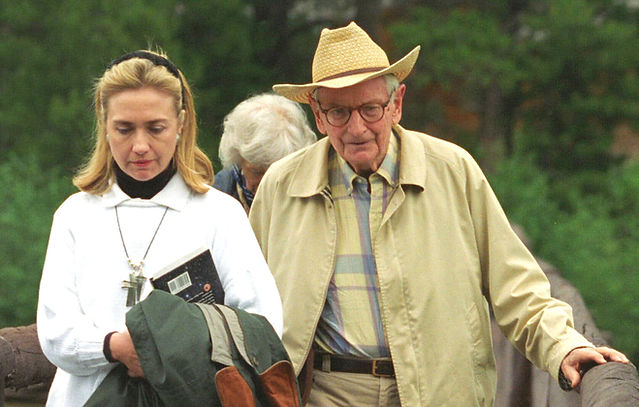
An extraordinary photograph from August 1995 adds another intriguing dimension. Bill and Hillary Clinton visited Rockefeller at his JY Ranch in Wyoming, and White House photographs captured Hillary walking alongside the 85-year-old philanthropist. In the photograph she is prominently seen carrying a book which enlargement positively identified as physicist Paul Davies' Are We Alone? Philosophical Implications of the Discovery of Extraterrestrial Life. It is said that Bill and Hillary were invited to the Rockefeller ranch to privately discuss the implications of visiting extraterrestrial life. It is interesting that this direct in-person meeting between Rockefeller and the Clintons about UFOs followed Rockefeller's intermediary appeals to them and the presidential science advisor relative to disclosure made the year prior.
ROCKEFELLER AND THE CRASHED UFO SCIENTIST

Rockefeller and Vannevar Bush
Perhaps the most telling thread about the Rockefeller story is that he was close to a scientist who was implicated in the study of UFO crash materials decades ago. Dr. Vannevar Bush was one of America's most influential wartime scientists and a former presidential science advisor. He also served as Chairman on the Department of Defense's Research and Development Board (RDB) established just two weeks after the Roswell UFO crash. The Rockefellers, including Laurance, were very close to Bush. Bush served, for instance, on the famous 1953 Rockefeller Committee, handpicked by the Secretary of Defense to reorganize the defense department. The project brought together prominent figures from government, business and academia. Rockefeller was so close to Bush that he funded Bush's development of the Differential Analyzer—a giant analog computer, when Bush was at MIT. Following WWII, Bush established a company called American Research and Development Corporation. Laurance Rockefeller's venture capitalists and Bush's tech entrepreneurs routinely met, co-investing in several early military electronics firms.
Bush was first identified as the head of a highly classified UFO crash-retrieval study by Canadian government senior engineer Wilbert Smith. Smith, who had some consultation with members of the RDB, had written a memo in 1950 on crashed UFOs which was discovered over two decades later by researchers. Smith's story about Bush originated from Dr. Robert Sarbacher. Sarbacher was a highly placed defense engineer and consultant to the RDB and later Dean of Georgia Tech. Sarbacher personally confirmed the contents of the Smith memo to three separate researchers in the 1980s. Yet another corroboration of Bush's involvement occurred in interviews in 1997 with Dr. Eric Walker, who served with Bush on the RDB and was later the President of Penn State University. He told researcher Scott Crain (working with Grant Cameron) that he did indeed know Bush and that he did attend meetings "concerning that matter." He also told them they were "chasing windmills" and to "let it go." He would not say more. Finally, Bush was implicated by Dr. Fred Darwin as Executive Director of the Missiles Committee of the RDB. When researcher William Steinman contacted him in 1984, Darwin stated that if a UFO recovery study program did happen, that he would place Vannevar Bush at the top of the list of those who would have been involved. Thus, decades before Laurance Rockefeller launched his own investigation into Roswell, he was operating within the same elite national-security circle as the man claimed to be overseeing America's secret crashed UFO effort. The connection is tantalizing.
Laurance Rockefeller died in 2004, leaving behind a remarkable documentary trail. He took America's most famous UFO mystery from the world of enthusiasts and placed it before the White House, enlisted family, pursued Roswell specifically, and financed a major UFO briefing document. There may have also been a more practical dimension to his curiosity: profit. The monetary incentive to commercialize extraterrestrial technology may have also been on his mind—he was known as a "space-age risk capitalist". Long before his UFO investigations, Rockefeller had invested heavily in aerospace and emerging technologies involving advanced and exotic materials. If UFO reports really did point to technology beyond anything then known on Earth, the potential economic implications would have been enormous. Whether that possibility figured in Rockefeller's thinking remains unknown. What is clear is that he devoted years, money and extraordinary access to determining if we are alone—or if we have been visited by those from elsewhere.